Mr John Abraham - memories and history of The Rotary Club of Waimate (1947-2005 & beyond).
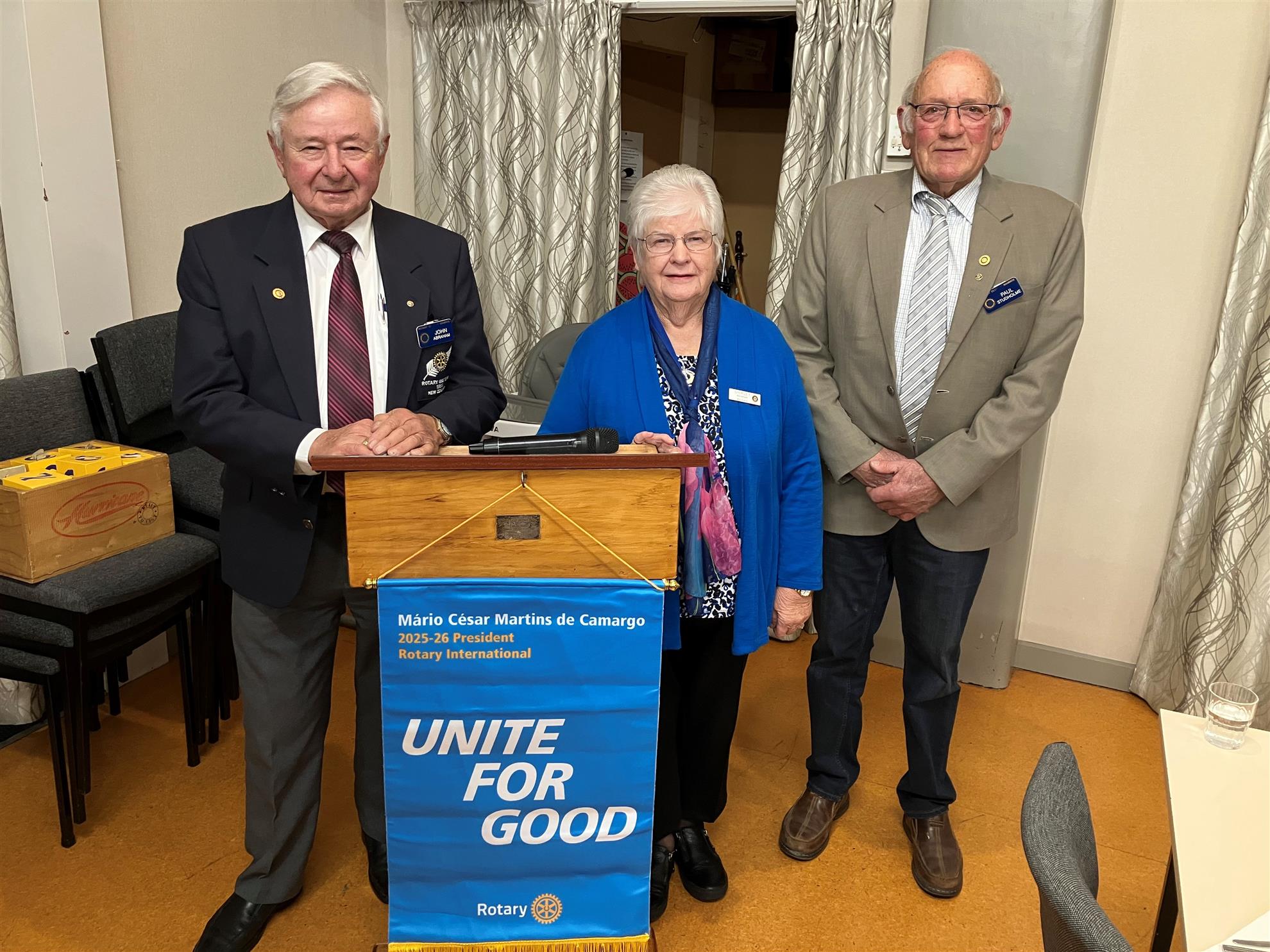
Good evening, everyone,
I have been invited to share some memories of my early membership in the club and what activities and projects were undertaken.
The first 20 years
Well to do that I need to give a short job talk and describe how I became a member.
My childhood was with my family at Willowbridge. in a cottage on Bill Fletcher’s farm where my father was a farm worker. Dad worked with a team of men including the “Boss,” Mr Bill Fletcher. My first knowledge of Rotary was in 1948 when Dad came home from work one Thursday to say “the boss knocked off at 4 o’clock again, to go to this new-fangled Rotary club meeting “.
The Club was chartered in 1947 and there were twenty-two charter members. Membership was by invitation only and according to a strict regime of classification. Bill Fletcher was elected in 1948, classification potato growing, member number 26. Arther Ruddenklau followed in 1952, classification mixed farming, member number 47.
Their sons are second generation current members of our club and are with us tonight.
Only one person from a recognised trade or profession could be a member of Rotary and our early member’s classifications included: -
Stock and Station agent, Religion Anglican, Share broker, Accountant, Railway transport, Bread baking, Hospital administration, Dentistry, Department Store, Footwear retailing, Medical services, Medical surgery, Draper, Vegetable Retailing, Meat retailing, Stud breeder, Motor Retailer, Barber, Banking. That is a lot of occupations that have disappeared from our community.
The meetings were held in the Savoy Tea Rooms and continued to do so for the next (65) years. I am sure that is some sort of record for continuous meeting at one venue, but it has never been acknowledged.
The club grew quickly and achieved some impressive projects.
Mr Joseph Atwill, had donated five aces of his land at Kelceys Bush to the Boy Scouts association and the club undertook to build a scout den on the property. The property was named Atwill Park, and the den is still in regular use today. It is a credit to the men who gave hundreds of hours of manual labour and there are photos in the archives of the members at work.
The other notable project came in 1955 when Alex McRae donated two and a half acres of land at the top of his farm for the club to plant in trees for future club funds. Again, there are photos of members driving 1940 and 1950 vintage vehicles up the dirt track to plant the trees. It took three attempts to get a crop started with the first two being cleaned up by wallabies. We all know the results of that initiative, and the legacy continues with the recent planting of the third crop. Incidentally, Alex named the block Hiwiroa Park, but the name has not been used in recent times.
The next 20 years
Fast forward 20 years and by 1967 I was in business and employing three tradesmen. It was in March 1967 when a man I vaguely knew rang and asked if he could bring 2 or 3 people to talk to me. No further explanation! I was still single and living with my parents and Mum was worried: “What the hell have you been up to?”
Well on the arranged evening Gerald Lewington together with Mayor Alex McRae and Accountant Mr Andrew McClay met with me in our lounge room and explained the duties and obligations of Rotary and invited me to join. Wow. I remember them being surprised when after some discussion I accepted there and then. I discovered later they were really chuffed at being successful with their salesmanship.
So, on the 7 May 1967, I was inducted into the Rotary club of Waimate by President Roger Englefield: -
John Abraham
Classification Active - Joinery Manufacturer
Club Name -John
At age 26 I was the youngest Rotarian in New Zealand. But that only lasted for about three months and then a young Chinese market gardener in Pukekohe became the youngest.
So, what did the club look like in the early years?
In a word, Formal! All members, or fellows, were addressed by their Christian name or club name and so for the first time in my life I had to call Mr Fletcher, “Bill” and the mayor “Alex.” I was the first of a new crop of members to be inducted and I was closely followed by Howard Rollinson, Donald Hunt, Alan Meyer, and Charles Ruddenklau.
My next vivid memory is the occasion of the clubs 21st birthday the following year. So, on the 14th of March 1968 in the St Pat’s Hall I was, as was the protocol of the time for all members, required to stand and introduce their guests. In my case it was my new bride. I was told later we looked like a couple of teenagers.
In June of that same year Rudd Brown was inducted as District Governor of District 298 which was still the whole of the South Island. Rudd’s induction as District Governor was a huge honour for the Club and a massive undertaking for Rudd, our local Pharmacist. He with wife Ruth, had the obligation to visit and address all the clubs in the South Island - we didn’t see much of him for the rest of his term as DG.
Everyone wore a suit or jacket, and all wore a white shirt and tie, no exceptions. On particularly hot evenings the president may declare “You may remove your jackets fellows”
The meeting began by singing grace and then followed a strict timetable with the meetings concluding sharp at 7.15 with singing God save the King. In 1953 that became God Save the Queen and the subsequently God defend New Zealand. The meal cost two shillings and six pence which in 1968, became 25cents. The meal was two-course on Savoy emblemed crockery with a cup of tea to follow.
Singing was an important part of meetings in those early years and there would be song books on the tables for every member and a sing-along of two or three of the old favourites, such as ‘Cruising down the river’ and ‘She’ll be comin’ round the Mountain’ etc. We always had numerous pianists including Rud Brown, Clarrie Hawkie and Harvey Moore.
Music and singing were a society norm in those days with most families owning a piano and Sunday evening singsongs around the piano were common. How thing have changed.
After the meal there was the command to “Clear the tables fellows” and then the cup of tea poured in Savoy teacups (no coffee - it was never served in those days) and then members would light up a fag. Almost every man smoked cigarettes and a sizeable number of smoked pipes. What a fog of smoke went up! I will always remember a line of men sitting in a row and lighting up their large pipes at the same time. It looked like a stubble paddock going up in flames.
The membership continued to grow and several men who had been members of Jaycees and Young farmers clubs joined us. There was a sort of natural progression that when you reached forty you moved on to Rotary. These men brought a new culture to the club and were skilled in debating, some having competed at national level. Thus, there were frequent interjections of “point of order Mr Chairman” and they would correct each other on finer points of meeting procedure to the extent we lost track of the original motion.
Another discipline of those days was attendance. Each member was “required” to attend a Rotary meeting each week and if not possible at your own club, then you were expected to “make up” at a neighbouring club. This meant that we frequently had visitors making up at our meetings and they would present a makeup card to the secretary to register their makeup attendance for the records. Miss three meetings and you were up before the directors to explain why. To have 100% attendance for the year was a highly prized achievement and some members had successive one hundred percenters. Donald Hunt was one of the most consistent achievers.
For me, a significant membership benefit was the association with successful businesspeople to draw on their experience and knowledge. Rotarian Roger Englefield had taken over his father’s plumbing business and taken the bold step to import one of the country’s first plastic injection machines to produce alkathene pipe. The success of this venture led him to import further machines and begin the Englefield range of White plastic bathroom and shower products, all happening in his Queen Street business. He subsequently sold the pipe business to two of his employees, Hank Murney and John Pugh who then shifted the plant to Ashburton. The company became the highly successful, RX Plastics. Rodger in turn shifted his bathroom ware business to Auckland and continued to be phenomenally successful. Englefield Plumbing became Bailey Plumbing and Doug joined our club in 1971. Also, at this time another member Maurice Thorby had started Debonaire Products manufacturing kitset bedroom furniture and continued to grow his business.
The advent of the annual fishing weekend was next. Initially using the shearers quarters at Te Akatarawa Station on the shores of Lake Aviemore. It began with Bert Govan who had been a cook in the army, together with Gordan Robbie deciding to cater the Saturday evening meal as a banquet with white tablecloths, flowers and provide an excellent meal with dessert. An occasion to remember. The Saturday night dinner continued to be a favourite part of the weekends and was usually followed with games of cards and a sing song with me on guitar.
.
In 1973 a huge project was to purchase the disused church at Otaio, remove the roof and shift it to a site in Goldsmith Street. Then rebuilding the roof and present the finished building to the Girl guides Association for use as their hall. Hundreds of volunteer hours over a three-year period all under the leadership of the late George Berry. The building has since been further shifted to Bushtown where it is the centre point of that property.
In 1979/80 the South Island District 980 ran a fund-raising project to build an accommodation unit for families of patients at the Burwood hospital spinal unit. One of the fundraisers was named Super Plod, a relay of Police running the length of the South Island. It was a tremendous success, and I still remember as president of the club running a few Ks through Waimate with local Policemen Barry McLachlan and Ray Currie.
In 1981 the district split into two districts with ours being renamed 9980 and ran from the Rangitata to Invercargill. It was good in many ways, but we lost contact with the Ashburton clubs.
Also in 1981, as President, I had the privilege of inducting a new member:
Edward Fletcher –
Classification- Asparagus growing –
Club name “Chub.”
In 1986 under the leadership of PDG Jim Rayner, the club organised a Sports and Fun day for people with disabilities. Competitors came from Canterbury and North Otago. 182 people of all ages competed in Olympic style events including medal presentations. It was a very heart-warming experience for us to work with these amazing people.
In 1988 there was an event I remember with Chub Fletcher as president. It was the clubs first introduction to modern technology. I was exporting to Australia and whilst on a business trip had taken time to visit the Rotary Down Under headquarters and met the then editor Hartley Tarrent. We agreed to exchange Fax messages during a meeting so at the right time I set up a fax line into the Savoy, brought my machine to rotary and Chub dialled the Sydney number and sent a message. The meeting continued and just before the conclusion the machine sprang to life and Hartley sent a reply. Amazing. But oh, how technology has developed from that early tech.
A highlight in 1989-1990 was the Club’s organising of the South Canterbury appeal for a Mammography Unit for Timaru Hospital. President`1223 Doug Bailey and Chub Fletcher were the instigators of the extraordinarily successful Telephone Appeal. $98,000 was raised through the Mammography Rotary Taskforce – a tremendous effort.
A major NZ social problem in the late eighties was unemployment, peaking at over 10%. I remember all Rotary clubs being encouraged to help and a District conference in Wanaka was devoted to a think tank to find small ways that could ease the problem. The result was Zip. The shift I remember most was to encourage people to retire early and therefore open an employment vacancy. People were considered anti-social if they worked beyond sixty. Early retirement became the expectation in government departments and Bruce Arthur lost his job as postmaster aged fifty-nine. Tough times.
Then in 1988/89 Ewan McKenzie was inducted as our next District Governor. This was a huge undertaking for Ewan and his success as DG is a story in itself. Well done, Ewan.
Also, in 1989 came the Rotary International directive for acceptance of Women into Rotary membership and this was a huge shift in culture for an all-male organization. Our club has embraced this change, and it has been a major factor in our continued strength.
Ten years later in 1998/99 Jim Rayner served as our third DG and then in 2005/06 Martin Jensen was the fourth member to be installed as District Governor. Four DGs from one club is a rare honour. But wait, there is more. Dylan Murray became our fifth DG and that is amazing.
Hours of planning goes into the hosting of four hundred plus delegates to a three-day conference, but the challenge galvanised the club into working together to ensure a successful result for all five conferences. At Ewan’s conference in Oamaru my standout memory is Doug Bailey’s marching girls. Fifteen blokes dressed in white skirts, white freezing works gumboots and frilly hats trying desperately to do a serious marching girls routine was a sight to behold.
Then 10 years later came Jim’s conference in Timaru and the undertaking to have a member on duty to personally welcome every person with a handshake each time they entered the conference venue.
In 2006 Martyn’s conference in Twizel was another success and I will never forget Gordon Ronson sitting on Martyn’s lap on stage performing a lip-sync love song. It absolutely brought the house down.
Dylan’s conference in our Event Centre was again, a phenomenally successful event and possibly will be the last club run district conference of that size.
Back to the nineties, another significant event in the culture of the club was the granting of a liquor licence. Until that happened about half the club went to the local for a drink before the meeting and, as a result, would arrive at the Savoy at 5 minutes to 6 pm, or in the case of Ron Hutt and a few others after six and miss the singing of grace. A finable offence. With the 1992 granting of a liquor license and Bruce Arthur managing a bar in the Savoy, members quickly changed to arriving early to enjoy a social time before the meeting and this has become an important part of our weekly meetings.
A significant activity of Rotary International was the Rotary Youth Exchange (RYE) programme. Organised on an International District to district basis, young people from different countries aged 15 to 20 were hosted by four Rotary families for one year. In its day, our district would have thirty or more exchange students at any one time. Our club has hosted regularly and had hosted eight young people up to 1995 and that in turn gave eligibility for eight of our own young people to experience a year overseas. Shirley and I served on the District Youth Exchange committee for 10 years up to 1995 and since then Raewyn and Raymond have served 12 years. The RYE programme is set to return in 2026.
Another Rotary International programme was Group Study Exchange. Our first member of a GSE exchange was Rob Sinclair in 1967 to USA and in 1991 Jenny Murphy was selected for a team to Wigan, England. In 1995 I was selected to be team leader of a team to Settle USA, an amazing experience that I will always value. This was followed in 1997 with Karen Keith to Osaka, then in more recent times Team leader Martyn Jensen to Finland, Rebecca Murray to Ireland and Ryan Luckman to India.
Then in March 1997 the club celebrated the 50th anniversary of its charter. What an occasion. We were honoured to have Charter member George Hewson present, and the celebrations were very well run. In preparation for the event retired High School teacher David Somers joined with Shirley and I to write the clubs 50-year history. The result was the publication of the Blue Book, which describes a huge amount of information on the club’s history, complete with historic photos. My talk this evening is a very brief snapshot of the book’s information. Each member of the club was given a copy but sadly only a few remain so if you have one, treasure it and please share it with newer members.
My company had grown to employ fifty people across two sites manufacturing dining chairs and tables and exporting 80% of the production to Australia, Japan, and USA. As the company grew so did the buildings and machinery. The club visited the factory on several occasions to view automatic woodturning lathes and then hi tec CNC machine centres. You could stand and watch those machines self-load and process the furniture parts for ages. On two separate occasions the club conducted its weekly meeting in a newly finished extensions to the building. However, from the year 2000 the world economy rapidly changed and in 2005 both Debonaire products and Abraham Furniture shut down their manufacturing operations. A sad day for Waimate losing sixty plus jobs.
The health, hunger, and humanity projects that Rotary International has sponsored over the years have been too numerous to detail but the Polio Plus campaign has been the longest running and the most significant. There have been many other causes that Rotary has initiated and supported and some of those names have changed including the Crippled Children Society, Intellectually Handicapped Children, the Foundation for the Blind, and the Leper appeal fund. For many years we held an annual fun day for the Crippled Children Society with visits to farms, picnics at Kelcey’s Bush, and of course, the fun jet boat rides on the Waihao river at Haymans flat.
In 2007 we ran the first of two Woodcraft Festivals with competitors and exhibitors coming from all over the South Island. My lasting memory of that event was the chainsaw carving young man from Nelson achieved of a Skink lizard carved in relief from a bent Macrocarpa Log. How did you visualise that I asked. “Ho, no problem” he said, he’s been in the log for years, I just let him out.” Sadly, that artist was killed in a forestry accident a few years later.
Our annual Foundation night auctions are legendary and the projects that have eventuated from accessing the foundation matching grant funds are too numerous to mention but the international stage has become a major part of the club’s activities. That together with GSE and Youth exchange have a wonderfully successful history.
The local project that has evolved and survived is Meals on Wheels. Commenced in 1955 with meals prepared by Woman’s organisations and delivered 3 days a week, this early community initiative has developed into an essential service providing meals 7 days a week to those in need. Many thanks go to the late Jim Young for his years of continued management of the rosters and to Raewyn Francis for continuing that role.
The four-way test was frequently recited at meetings to remind us of the principles of business ethics and although it is not so frequently used now it is still a valuable yardstick to measure our behaviour of the things we say and do (displayed on our notice board each week):
“Is it the truth?”
“Is it fair to all concerned?”
“Will it build goodwill and better friendships?”
“Will it be beneficial to all concerned?”
So, for 60 years the club activities revolved around community service and undertaking projects that required fundraising. Wood chopping and distribution to the elderly, hay bailing and carting, white elephant collections and auctions etc all involving working bees with great fellowship and camaraderie.
Since then, the shift has been to international projects of a large scale, and I feel the club members have lost the personal contact with those far away projects. Sad but that is progress in our ever-changing world.
The years from 2005 on is another story and one for future members to record and remember and hopefully complete the 100-year history in due course.
It has been a privilege to meet each week for 58 years with positive thinking people, and I hope to continue for a few more years yet.
Cheers,
John Abraham